
NC3Rs: National Centre for the Replacement Refinement & Reduction of Animals in Research
Strategic grant

Advanced 3D in vitro modelling of inflammatory bowel disease for evaluating biologic treatment efficacy and enabling computational analysis
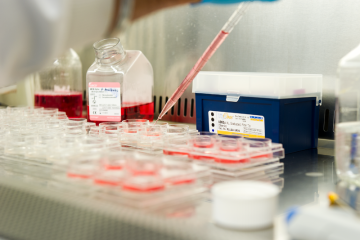
The arm of a researcher pipetting cell culture media into multi-well plates

At a glance

In progress
Award date
March 2026 - September 2026
Grant amount
£22,872
Principal investigator
Dr Paloma Ordóñez-Morán
Institute
University of Nottingham

R

  • Replacement

Overview

Paloma will work with AstraZeneca to use patient-derived organoids as an in vitro model to study inflammatory bowel disease, a condition associated with increased colorectal cancer risk. Current studies typically rely on chemically or genetically inducing colon damage in mice. By retaining patient-derived characteristics, the organoids will enable the team to assess phenotypic and molecular responses to clinically-relevant compounds. The experimental data will then be integrated with existing clinical datasets using computational approaches to carry out preliminary analyses of treatment responses and disease progression. 

Application abstract

This collaborative interdisciplinary project unites expertise in experimental biology from the University of Nottingham with computational modelling capabilities from AstraZeneca, Cambridge UK, to transform how Inflammatory Bowel Disease (IBD) patients are treated by using a strong 3Rs approach. Our core goal is to move beyond traditional animal-based research by combining innovative preclinical models including patient-derived organoids and humanised in vitro systems with patient-derived clinical data, all integrated through advanced computational platforms. This seamless integration allows us to address pressing questions in IBD molecular pathology and therapeutics with far greater human relevance.  

IBD presents a rapidly growing healthcare challenge, currently affecting over six to eight million people globally. Patients not only suffer a heavy disease burden but also face a nearly six-fold increased risk of developing colorectal cancer, which is responsible for 15% of deaths among this group. By focusing on non-animal model systems, our project aims to deliver more precise mechanistic insights into disease progression and therapeutic response, supporting the discovery and validation of new targets for IBD treatment.  

A key innovation of this project is the use of data-driven approaches, employing advanced and physiologically relevant models to predict disease trajectory and response to therapy in IBD. By integrating computational modelling with human-derived preclinical systems, we can offer more precise and reliable predictions compared to traditional methods. Furthermore, the successful implementation of these models will enable accelerated uptake by the wider research community. This broad adoption will amplify the impact of the 3Rs, as researchers increasingly leverage these improved models to study IBD and other conditions. In the longer term, our work supports a step change in animal research practice and scientific standards, helping drive the development of alternatives that are more predictive and directly relevant to human disease.