Finding the balance: Protecting human health and minimising animal suffering
NC3Rs Head of Toxicology Dr Fiona Sewell discusses collaborating with the global toxicology community to reduce and refine animal use in developmental and reproductive toxicity (DART) studies.
In June, the European Chemicals Agency (ECHA) – which oversees chemical safety assessment requirements under the EU REACH (Registration, Evaluation, Authorisation and Restriction of Chemicals) Regulation – published an update to its advice on dose-level selection for DART studies. The advice follows several years of discussion between regulators, the chemicals industry, contract research organisations (CROs) and the wider scientific community on the interpretation and application of recommendations made by ECHA in 2022. With considerable differences in views about the workability of the guidance and the impacts on animals used, the NC3Rs is a leading voice in facilitating discussions to seek clarity and consensus to ensure chemicals are only tested at the lowest doses necessary to assure protection of human health.
NC3Rs Head of Toxicology Dr Fiona Sewell reflects on the importance of a scientific approach to dose-level selection, four years of collaboration with the toxicology community and why the conversation is far from over.
Getting the balance right
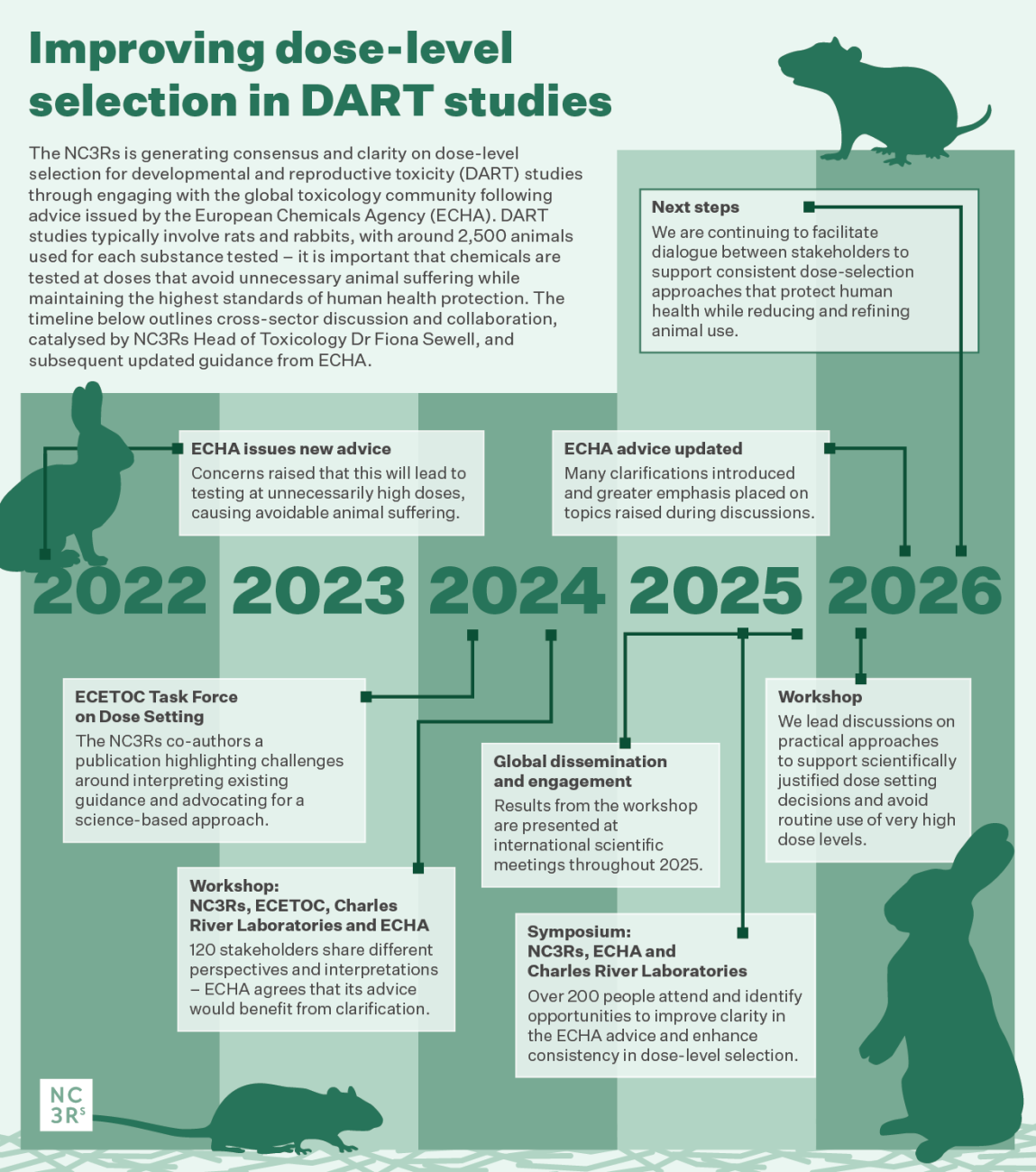
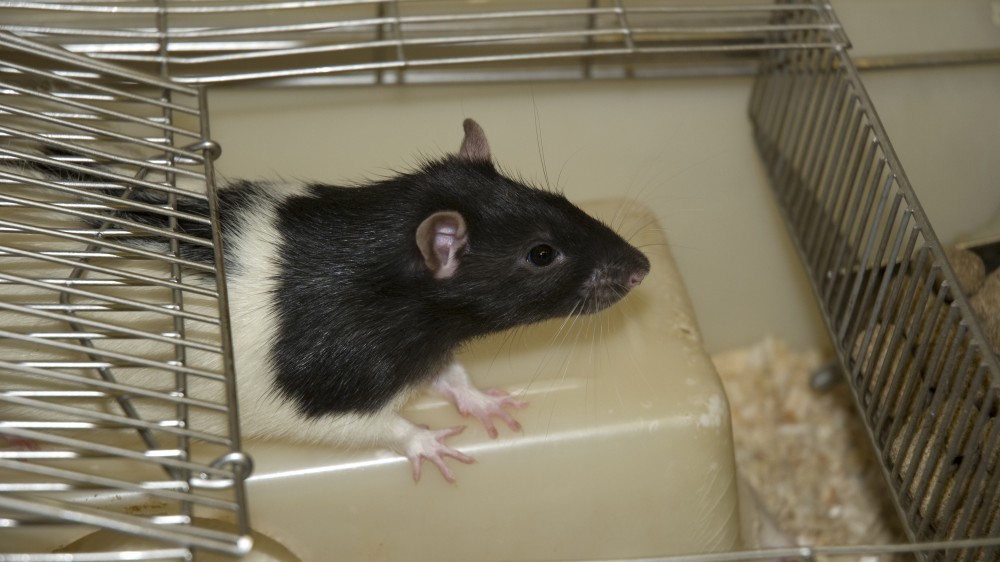
DART studies in animals are used to assess whether chemicals may affect fertility, pregnancy or the healthy development of offspring. These studies typically involve testing in rats and rabbits, with around 2,500 animals used for each substance tested. Selecting which doses to test in DART studies is critical to support robust safety decisions while avoiding unnecessary animal suffering. However, it remains one of the most challenging questions in regulatory toxicology. Doses that are too low may fail to detect important potential risks to human health whereas excessively high doses can cause severe toxicity, causing considerable animal suffering and affecting study outcomes. Doses that are either too low or too high can create difficulties in data interpretation potentially leading to the need for repeat studies and further animal use.
In 2022, ECHA published advice intended to clarify how the existing REACH requirement to test at "appropriately high dose levels" should be interpreted and applied in reproductive toxicity studies. The advice prompted extensive and sometimes heated discussion across the toxicology community, primarily around what constitutes a "high enough" dose and how this can be defined and identified in practice. Concern was raised that aspects of the ECHA advice did not align with existing guidance and could potentially lead to testing at excessively high doses in animals.
Bringing different perspectives together
Using my experience of bringing organisations together to tackle complex topics I have been pleased to be able to play a key role in facilitating discussions with colleagues from industry, CROs, consultancies and regulatory bodies to better understand the concerns, identify areas in need of clarification and explore practical solutions that protect animal welfare and human safety. In 2024, as part of the European Centre for Ecotoxicology and Toxicology of Chemicals (ECETOC) Task Force on Dose Selection, I was co-author on a paper advocating for a scientific approach to selecting doses for DART studies to avoid exposing animals to unnecessarily high doses of test substances. Later that year we held a joint workshop co-organised by the NC3Rs, ECETOC, Charles River Laboratories and ECHA, which brought together delegates from the UK, Europe, USA and Asia to share perspectives on dose setting for DART studies and discuss the latest ECHA advice in depth. Having stakeholders from different countries and sectors in the room together was invaluable to demonstrate how the advice was being interpreted and applied in the real world and the resulting practical implications in terms of regulatory decision-making, study design and harms to animals. The outcomes were written up in a workshop report and peer-reviewed publication and presented at international conferences and meetings across 2025.
As the discussions progressed it became clear that stakeholders were less far apart than it initially appeared which helped identify areas of agreement and highlight where further dialogue was needed. Importantly, ECHA were active participants in many of these conversations. During discussions ECHA acknowledged that many studies, particularly those conducted by larger and more experienced organisations, were already being dosed appropriately. Rather than intending to suggest that dose levels needed to be raised across the board, the advice was prompted by specific examples where ECHA considered that dose levels were not high enough to assure chemical safety with sufficient confidence.
Shifting discussions from continued debate to practical solutions, over 200 people attended a symposium we co-hosted at EUROTOX last year with ECHA and Charles River Laboratories. Alongside a workshop at the Society of Toxicology Annual Meeting in March 2026, these sessions focused on developing recommendations to improve existing guidance and support the use of approaches that enable scientifically driven decisions on dose selection.
Signs of progress
In June 2026, ECHA published revised advice on dose selection for reproductive toxicity studies. The revisions do not fundamentally change the underlying approach of testing at “appropriately high dose levels” and stakeholders are concerned that uncertainties around how this should be interpreted and applied in practice remain unresolved. However, several revisions provide additional clarification and place greater emphasis on topics that have featured prominently throughout our discussions with the global toxicology community. These include a stronger emphasis on evidence-based dose selection, additional consideration for steep dose-response relationships and dose spacing, clarification around sex-specific dosing considerations and greater recognition of the importance of dose-range finding studies – all factors that are critical in determining doses that avoid unnecessary suffering in animals and minimise the likelihood of severe suffering.
One of the central questions at the heart of this debate remains unresolved – with ECHA advice to aim for the “highest possible dose level without severe suffering or death”, how can this be practically demonstrated without causing severe suffering or death in some animals? The real challenge lies in determining when a dose is sufficiently high to provide clear evidence on reproductive toxicity, rather than continuing dose escalation towards the highest possible dose.
The OECD Guidance Document which guides the recognition of animal suffering and the use of humane endpoints – predetermined clinical signs at which point the study needs to be terminated or interventions taken to avoid further suffering – was published more than 25 years ago, at a time when knowledge and approaches to animal welfare were very different. Guidance on recognising and assessing severe suffering has not kept pace with developments in toxicology, animal welfare science and regulatory expectations. An underlying issue in dose setting is differences in how humane endpoints are interpreted and applied across organisations, countries and study types. There is strong support from the chemicals industry for better and more harmonised guidance on humane endpoints that addresses how avoiding severe suffering should influence dose-setting decisions in practice.
Looking ahead
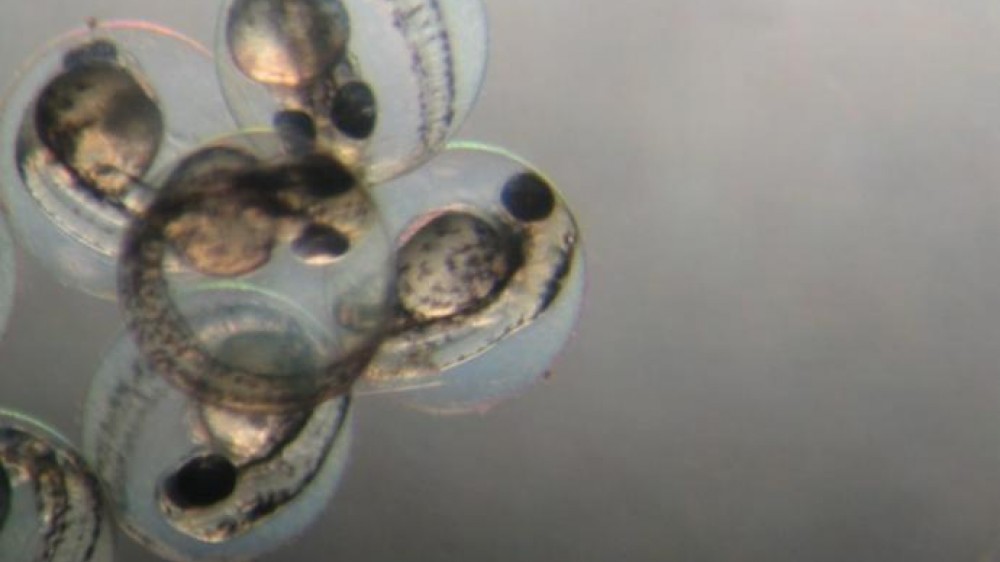
The publication of ECHA's revised advice marks an important milestone in an ongoing discussion about how best to balance scientific objectives, regulatory requirements and animal welfare considerations when selecting doses for DART studies. However, there is still a risk of inconsistent approaches to dose setting between the organisations conducting DART studies and the regulators interpreting the resulting data. Continued dialogue and further improvement of guidance and advice is needed to avoid unnecessary suffering and reduce the likelihood of additional animal studies. Questions remain around how scientists define and interpret toxicity, animal suffering and humane endpoints, and how these decisions can be applied consistently across different studies and organisations. In the longer term, the aim is to continue advancing the development and adoption of non-animal approaches that reduce reliance on animal DART testing altogether. The NC3Rs has funded the development of a number of new approach methodologies (NAMs) for this purpose, including the use of zebrafish embryos, nematode worms and social amoeba as partial replacements alongside 3D cell culture and computational approaches.
The last few years have highlighted the value of bringing stakeholders together, to openly discuss challenging issues, understand different perspectives and identify areas where common ground exists. I would welcome even broader stakeholder involvement in future discussions on guidance development and implementation, including veterinarians and animal welfare experts whose perspectives are critical to achieving the right balance between scientific objectives and animal welfare. The NC3Rs will continue to facilitate discussion in this area and provide a neutral forum for sharing experience, data and best practice.
Learn more about this work on our project page.
Including the use of zebrafish embryos, 3D cell cultures, nematode worms, social amoeba and computational approaches.