
How many animals are used in research?
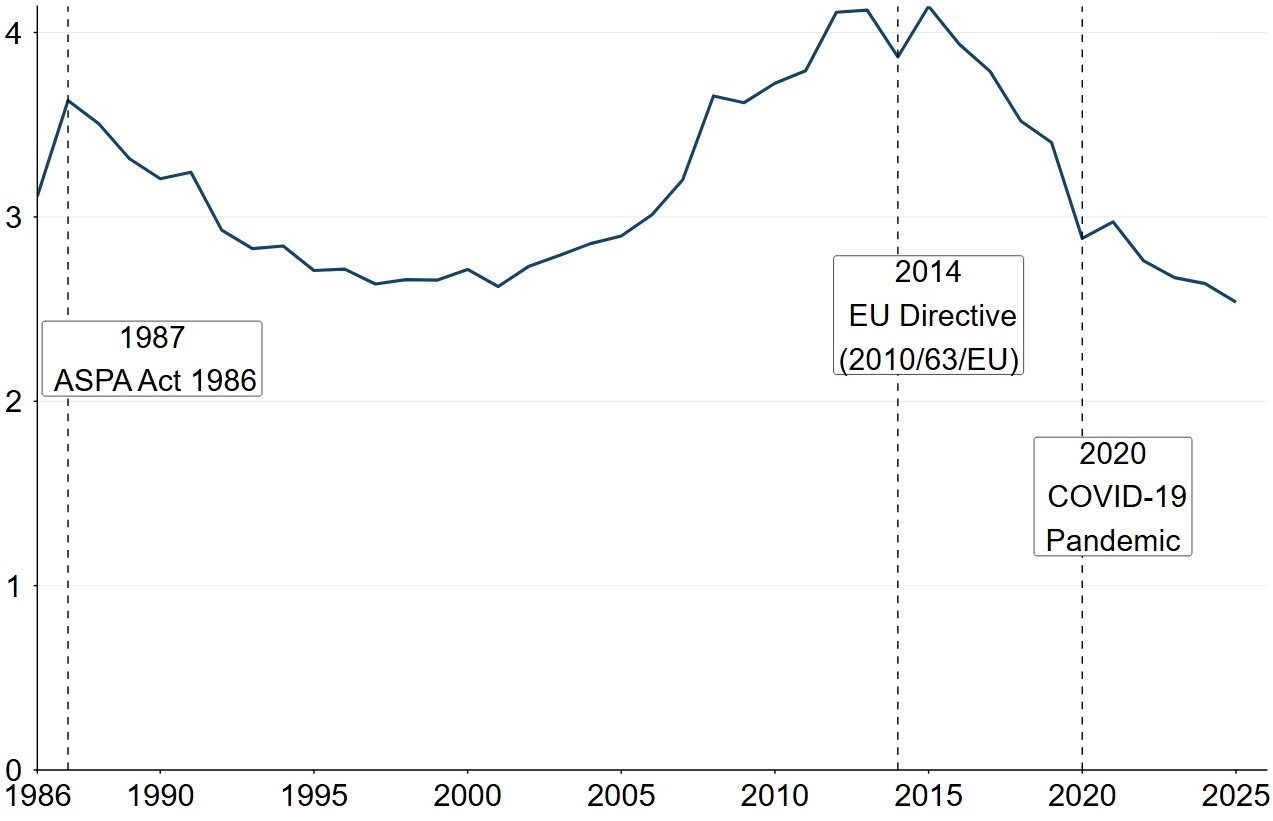
In Great Britain in 2025, 2.54 million procedures were carried out involving living animals. Mice, fish, birds and rats account for 95% of this figure but other animals, including dogs and monkeys, are also used.
In this context, the term procedures means:
- Using animals in scientific studies, such as experiments to increase scientific knowledge, medical research and safety testing (see How are animals used in research? for more details).
- Breeding animals whose genes have mutated or been modified – these animals are used to produce genetically altered offspring that are used in research, rather than being used themselves.
The actual number of animals used is lower than the number of procedures because individual animals may undergo more than one procedure.
How has the number of procedures changed?
The annual number of procedures decreased across the 1990s before increasing in the early 2000s. Over the next decade the numbers fluctuated around 4 million, reaching a peak of 4.14 million in 2015. There has since been a downward trend in the number of procedures and the latest figures for 2025 were the lowest on record, with 2.54 million procedures involving living animals. The annual figures are affected by factors such as research trends, the development of new technologies, the research funding climate and global events (for example, the COVID-19 pandemic reduced the amount of scientific research being performed worldwide in 2020).
What about the rest of the world?
It is hard to get an accurate figure for the number of animals used or procedures performed worldwide because other countries collect this data differently and some do not collect it at all. In the European Union (plus Norway) the latest available data is for 2023, when there were 8.08 million uses of animals for scientific purposes (EU statistical report, 2023). In the USA, the reported number of animals used in 2025 was 0.75 million (US research facility annual report summary, 2025), but this figure is a huge underestimate because it does not include mice, rats, fish and birds which are the most commonly used species.