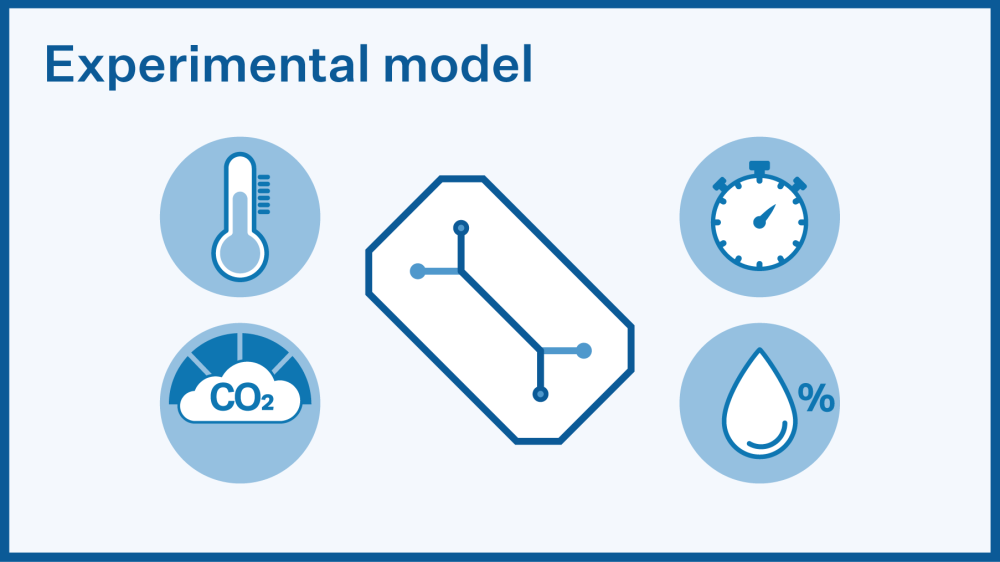
DRIVER recommendations – Experimental model
How to design experiments with an appropriate model for the research question and report all required details of how models were maintained and used.
Item 3: Experimental model
In an in vitro experiment, the experimental model is the system that is used to investigate the research question. It is vital that experiments are designed considering if the model can answer the research question and then reported in sufficient detail to allow others to replicate the same experimental conditions with the same model.
You can find helpful tips and additional context in the grey boxes in each section below.
Design recommendation
Considerations around identifying a model to achieve the aims of an experiment.
Determining how models will be maintained prior to and during experiments.
Identify the model that will be used in each experiment
In an in vitro study, the experimental model is the system that is used to investigate the research question. In this context, the model may be cell-free (e.g. involving the direct interaction between proteins and small molecules), or involve the use of living cells, microorganisms, or tissues derived from human, animal, plant or other living sources.
For more information on the different types of in vitro models see the interactive content (i. What is the experimental model?).
The requirements for establishing and maintaining an experimental model will vary depending on the type and complexity of the model. Selecting an appropriate model is essential to ensure that it can provide meaningful insights into the disease, condition or biological phenomenon being studied. Clearly defining the questions the model is intended to address, and the characteristics it must possess, can help to inform this choice. For example:
- Testing enzyme activity may only require the enzyme and its substrate; in this case, the system used to investigate the research question could be the isolated enzyme.
- Modelling changes in gene expression requires a system capable of capturing cellular signalling and regulatory processes; this typically requires living cells and may be studied using single cell culture.
- Modelling cell-to-cell interactions requires multiple cells (and often multiple cell types) to be cultured together so that these interactions can be observed.
- Modelling physiological conditions typically requires more complex systems that can better recapitulate tissue or organ level structure and function (e.g. organoids).
Crucially, the experimental model must be capable of answering the research question by capturing the aspects of the biology that are central to the study. Other considerations include, but are not limited to:
- Generalisability: The generalisability of an experiment can be influenced by the model used. An experiment conducted using a single cell line will generally be specific to that particular cell line. In contrast, using multiple cell lines, or more complex systems such as co‑cultures or microfluidic platforms, can increase the generalisability of the results.
See Item 1: Experimental unit for more information on generalisability and how it is related to the biological unit.
- Practicality and ease of use: Some models can be challenging to maintain within the parameters needed to yield reliable and interpretable results. It may be necessary to balance the potential scientific value of a highly complex model against the ability to perform the experiment and gather meaningful data.
- Maintenance requirements: Complex models, such as organoids or organ-on-chip systems, often require specialised equipment, technical expertise and specific reagents.
These additional resource needs should be considered during model selection to ensure the work is feasible and sustainable (see interactive content – ii. Maintaining the model)
Establish how models will be maintained
How in vitro models are maintained prior to conducting experiments can have implications on the experimental outcomes. Cells and cell lines are highly sensitive to their physical and chemical environment, and changes in the environment can have a range of effects from phenotypic changes to cell death. Differences in these conditions across experimental units can also provide a source of bias (see Item 2: Risk of bias).
Factors to consider include:
- Temperature, CO2 concentration and humidity of the incubator.
- Media composition.
- Use of antibiotics or antimycotics.
- Duration of maintenance.
- Mycoplasma status.
- Number of population doublings.
- Plasticware.
- Cell surface stiffness and topography.
Contamination, misidentification as well as phenotypic and genotypic drift are well recognised risks associated with in vitro models, particularly immortalised cell lines. It is essential to authenticate cell lines before experiments are conducted, as well as ensuring the model is able to achieve the experimental aims (e.g. expressing a protein of interest). The importance of these measures is explored in more detail in the interactive content (iii. Authentication and quality control).
When establishing a new model, benchmarking should be built into the study design and conducted prior to experiments to ensure the novel model matches or improves on existing models.
During experiments the treatments applied may alter the conditions under which the model is maintained. In addition, the need to capture data can expose models to sub‑optimal environments (e.g. extended periods outside the incubator). Where possible, adjustments should be made to the experimental design to minimise or control for these effects. For instance, measurements can be taken in batches to reduce the time models spend outside optimal conditions.
Reporting recommendation
How to report full details of the model used and how it was maintained.
Key factors to consider including model stability and characterisation.
Describe model characteristics and maintenance conditions
When reporting the use of complex models, a diagram or schematic of the model system may be useful to communicate its design and structure. Important details to report for each model include:
- The identity of any cells or cell lines used, including their source and whether they have been characterised (along with how this was performed) and/or authenticated (e.g. by karyotyping or genetic testing). It is also useful to describe why specific cells were chosen (for example, whether they express a target protein of interest).
- For human- or animal-derived samples, induced pluripotent stem cells (iPSCs), organoids or similar models, as well as established cell lines, report details of the species, sex, age, ethnicity and other relevant characteristics of the source – human or animal. Where human samples are used, ensure these details cannot be used to identify specific individuals. Details of relevant ethical approvals should also be provided.
- Details of how cells or samples were managed in advance of the experiment, including extraction processes, the temperature, CO2 concentration and humidity at which they were cultured, the composition of the medium in which they were maintained (including whether antibiotics or antimycotics were used), the duration of their maintenance, mycoplasma status, number of population doublings and their confluency at the start of the experiment.
Report experimental conditions and model suitability
It is important to fully report the specific conditions under which experimental procedures were conducted. This might differ from maintenance conditions. Key information to report include:
- Details of the physical and chemical environment in which the experiment took place. This includes details of the physical environment’s set-up (e.g. whether the experiment took place in suspension or adherent cell culture plasticware, microfluidic chips, hydrogels, organoids, using structural scaffolds or other physical environment), and the temperature, CO2 concentration, humidity and composition of the medium or substrate in which the experiment was performed.
- If cells were used, details of any assessment of cell viability, cell number and phenotypic stability within the model, including the methods used to perform these assessments.
- Details of any quality control metrics or assessment for the different components of the experimental model. This applies to not only the biological material used (e.g. cells) but also to reagents or materials used to generate the experimental model (e.g. devices or substrates).
- Details of any prior validation of the model or method. This could include characterisation of the model performed by the researchers themselves, previous publications demonstrating the applicability of the model to the research question or information on acceptance of the model as part of published international test guidelines.
For studies describing novel or adapted experimental models, it is important to include information on how the model was developed, characterised and/or benchmarked. This is especially true for studies describing complex in vitro models, such as three-dimensional cell cultures, organ-on-chip or organoids. Depositing detailed protocols for how such models are generated in openly accessible repositories is also strongly encouraged.
- Pamies D et al. (2022). Guidance document on good cell and tissue culture practice 2.0 (GCCP 2.0). ALTEX 39: 30-70. doi: 10.14573/altex.2111011
- Plant AL et al. (2014). Improved reproducibility by assuring confidence in measurements in biomedical research. Nature Methods 11(9): 895-898. doi: 10.1038/nmeth.3076
- Almeida JL et al. (2016). Standards for cell line authentication and beyond. PLoS Biology 14(6): e1002476. doi: 10.1371/journal.pbio.1002476
- Lepock JR (2005). How do cells respond to their thermal environment? International Journal of Hyperthermia 21(8): 681-687. doi: 10.1080/02656730500307298
- Olarerin-George AO and Hogenesch JB (2015). Assessing the prevalence of mycoplasma contamination in cell culture via a survey of NCBI's RNA-seq archive. Nucleic Acids Research 43(5): 2535-2542. doi: 10.1093/nar/gkv136
- American Type Culture Collection (2026). Passage number effects in cell lines.
- Pavel M et al. (2018). Contact inhibition controls cell survival and proliferation via YAP/TAZ-autophagy axis. Nature Communications 9(1): 2961. doi: 10.1038/s41467-018-05388-x
- Efremov YM et al. (2013). The effects of confluency on cell mechanical properties. Journal of Biomechanics 46(6): 1081-1087. doi: 10.1016/j.jbiomech.2013.01.022
- Poon MTC et al. (2021). Temozolomide sensitivity of malignant glioma cell lines: a systematic review assessing consistencies between in vitro studies. BMC Cancer 21(1): 1240. doi: 10.1186/s12885-021-08972-5
- Sander T et al. (2022). Meta-analysis on reporting practices as a source of heterogeneity in in vitro cancer research. BMJ Open Science 6(1): e100272. doi: 10.1136/bmjos-2021-100272
A set of six items tailored to the design and reporting of in vitro experiments. Find out more on the landing page.

Go to Item 1: Experimental unit.
Go to Item 2: Risk of bias.
You are on this page.
Go to Item 4: Experimental procedures.
Go to Item 5: Experimental groups and exclusions.