DRIVER recommendations – Experimental unit
How to identify and report the experimental unit and other associated experimental entities.
Item 1: Experimental unit
When designing a study, it is essential to identify the experimental unit – the entity on which the experiment is being carried out. Reporting the experimental unit enables other researchers to understand how the hypothesis is being tested, the design of each experiment and the number of times the experimental procedures have been replicated (i.e. the sample size). It is useful to understand the concept of the experimental unit and distinguish it from other types of experimental entities, such as the biological unit.
You can find helpful tips and additional context in the grey boxes in each section below.
Design recommendation
Guidance on identifying key experimental entities to support robust and reliable experimental design
How to determine the external validity of an experiment in the context of the biological unit.
How to correctly identify the experimental unit and other components of an experiment
The experimental unit is the entity that is independently assigned to different experimental groups to receive one of the treatment interventions during the study.
The experimental unit is a complex concept, with other similar but distinct terms used alongside it. If this is the first time you are looking to define your experimental unit and you are relatively new to the terms used on this page, you will find the interactive content helpful in providing a thorough grounding in the concepts with worked examples to put them into real-life context.
Other related, but distinct, terms that can be used to describe entities in in vitro experiments include:
- The biological unit of interest – the entity that a researcher wants to make an inference about, for example it could be an animal, a cell, a tissue or an organelle. The purpose of a study is to test a hypothesis or to estimate a property regarding these biological units.
- The observational unit – the entity from which measurements are taken, which may or may not correspond to the experimental unit.
The distinction between experimental, biological and observational units is important, because in many cases the three may be different from one another. This terminology provides clarity that is often lacking in commonly used terms such as “biological” and “technical” replicates, which are frequently used to refer to genuine replication and sub-sampling (see below), respectively, but are often inconsistently defined or misapplied, obscuring the independence of experimental entities.
For an entity to be considered an independent experimental unit, it needs to meet the following criteria:
- It is possible to randomly and independently assign it to any experimental group.
- Have experimental interventions (e.g. test compounds) applied independently from other experimental units.
- Experimental units should not influence each other, either within or between experimental groups.
How to identify the experimental, biological and observational unit is explored further in the interactive content (i. Identifying your units).
Genuine replication increases confidence in the reliability and reproducibility of experimental findings. It involves applying the same experimental procedures to multiple independent experimental units and collecting observations from each unit.
Because the number of experimental units is equal to the sample size, genuine replication increases the sample size of an experiment.
Replicating experimental procedures on non-independent units, but treating these as if they were independent, is known as pseudoreplication.
This is introduced when multiple measurements are taken from the same experimental unit but are treated as independent. It occurs when the experimental unit is misidentified, for example individual observational units may be treated as experimental units incorrectly.
Pseudoreplication does not increase the sample size of an experiment, even if there are more data points. Rather, it underestimates the true variability within an experiment. Measurements from the same experimental unit will be more similar to each other than those from separate independent experimental units. Pseudoreplication increases the risk of both false-positive and false-negative results.
If an experiment requires multiple measurements from the same experimental unit – known as sub-sampling – this must be accounted for in the analysis. Sub-sampling can provide a more precise estimate, but the measurements are not independent. To address this, you can average the sub-samples for each experimental unit. It is important to note that including each individual measurement in the analysis would introduce non-independent data, leading to pseudoreplication. This compromises the validity of the analysis, underestimates the true variability and artificially inflates statistical significance.
Misidentifying the experimental unit can have significant effects on the validity of the results and in particular any statistical analysis, because the sample size for a study equals the number of experimental units.
To explore pseudoreplication, and the effects it can have on the analysis in more detail see the interactive content (ii. Experimental unit) for a worked example.
Consider how the biological unit you select affects generalisability
The biological unit is the entity about which you are making inferences. The experiment is designed to test a hypothesis or estimate a property of this entity. Depending on the experiment, the biological unit may be a whole animal or human, a tissue, a cell, an organelle or another biological entity. It is important to clearly identify the biological unit because the outcomes of the experiment are based on this entity.
Increasing the number of biological units in an experiment improves the generalisability of the results. If only one biological unit (e.g. a single cell line) is used, it is unclear how applicable the findings are beyond that unit.
In general, the results of an experiment apply only to the population from which the experimental units were drawn. Increasing the sample size (i.e. the number of experimental units) strengthens the conclusions but does not extend their applicability beyond that population. By contrast, increasing the number of biological units can broaden applicability; if consistent results are observed across multiple independent experimental units from different biological units, this suggests the findings are more generalisable.
This is demonstrated in the figure below showing two experiments with the same sample size, but one uses four lung cancer cell lines and the other uses only one. The results of Design A only allow conclusions to be made on the treatments effects on that particular cell line, while Design B, using four cell lines, can be better generalised to apply to lung cancer.
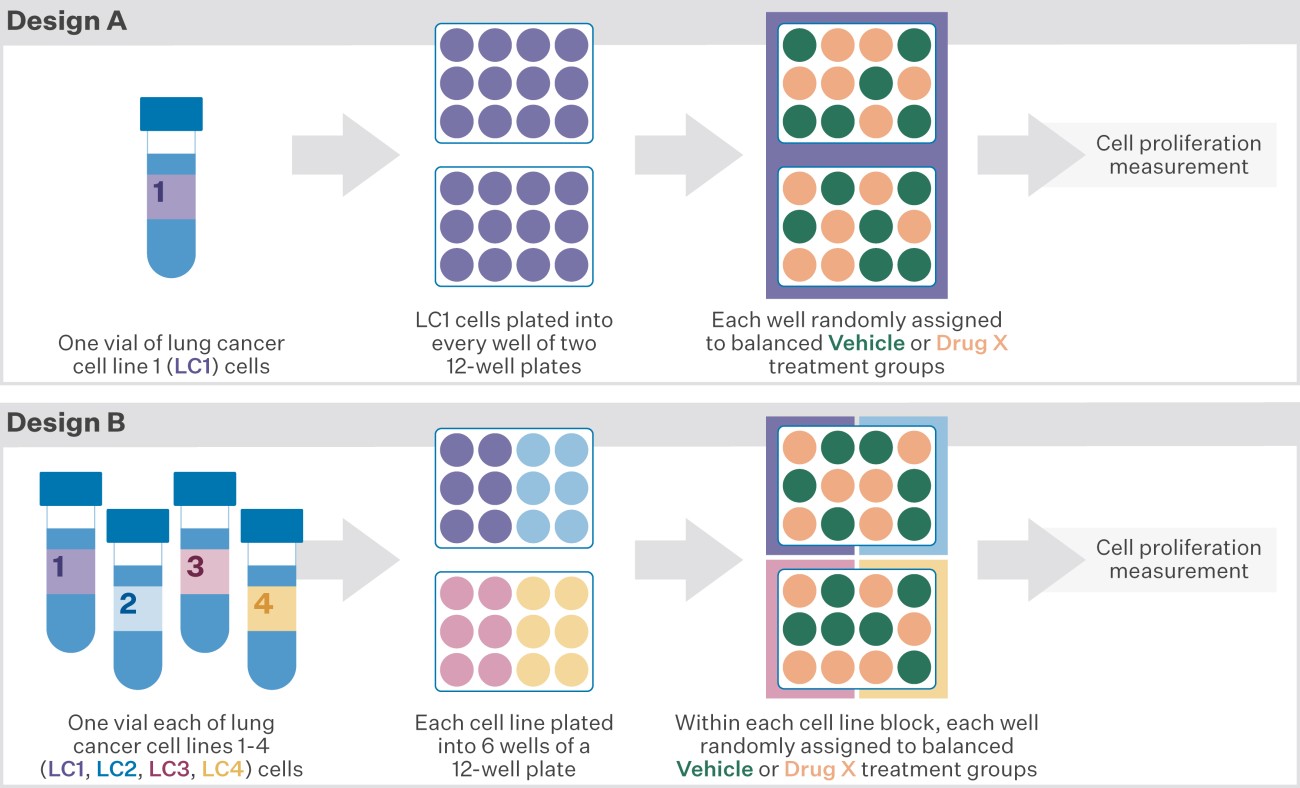
For a more in depth look at this example and the pros and cons of both experimental designs see the interactive content (iii. Biological unit).
Reporting recommendation
The experimental and biological unit should be clearly identified for each experiment. This is particularly important where the experimental, biological and observational units are different. It ensures that the sample size for each experiment is clear. Pseudoreplication and inadequate reporting of the experimental unit are prevalent in in vitro studies. This can be exacerbated by the use of inappropriate terminology such as biological and technical replicates, which do not clearly define what the sample size relates to.
Researchers commonly use the terms 'biological replicate' and 'technical replicate', however, what these terms are used to represent can vary. In general, a biological replicate is used to refer to genuine replication and technical replicate can be used to describe either sub-sampling or pseudoreplicates.
The terms ‘biological replicate’ and ‘technical replicate’ do not capture the important characteristics of an experiment. Their use can blur important distinctions and help justify a poor experimental design. Using experimental, biological and observational unit instead avoids this ambiguity and provides key information on the experimental design.
If sub-sampling was part of the experimental design, how the sub-samples were accounted for must be described (e.g. averaging multiple readings sampled from a single experimental unit).
How this data is presented should also be considered, as plotting individual readings from sub-samples on a graph may suggest these are independent experimental units (see Item 6: Data availability and presentation).
Interpreting the results of a study should take into account the biological units used and generalisability of the findings. If a single biological unit was used, the results can not be generalised beyond that biological unit and this should be reflected when reporting and discussing the findings.
Consider including an experimental design section with the methods to report the experimental and biological units for all experiments along with other experimental design considerations such as bias mitigations (see Item 2: Risk of bias).
Providing a dedicated section allows for the units to be transparently and clearly defined and avoids readers and reviewers having to interpret what the experimental unit is from the methods, results and n number in figure legends.
- Vaux DL et al. (2012). Replicates and repeats: what is the difference and is it significant? A brief discussion of statistics and experimental design. EMBO Reports 13(4): 291-296. doi: 10.1038/embor.2012.36
- Festing MFW (2003). Principles: the need for better experimental design. Trends in Pharmacological Sciences 24(7): 341-345. doi: 10.1016/S0165-6147(03)00159-7
- Casella G (2008). Statistical Design. Springer.
- Mead R et al. (2012). Statistical Principles for the Design of Experiments: Applications to Real Experiments. Cambridge University Press.
- Lazic SE (2016). Experimental Design for Laboratory Biologists: Maximising Information and Improving Reproducibility. Cambridge University Press.
- Lazic SE et al. (2018). What exactly is 'N' in cell culture and animal experiments? PLoS Biology 16(4): e2005282. doi: 10.1371/journal.pbio.2005282
- Lazic SE (2022). Genuine replication and pseudoreplication. Nature Reviews Methods Primers 2(1): 23. doi: 10.1038/s43586-022-00114-w
- Lazic SE (2010). The problem of pseudoreplication in neuroscientific studies: is it affecting your analysis? BMC Neuroscience 11: 5. doi: 10.1186/1471-2202-11-5
- Aarts E et al. (2014). A solution to dependency: using multilevel analysis to accommodate nested data. Nature Neuroscience 17(4): 491-496. doi: 10.1038/nn.3648
- Sikkel MB et al. (2017). Hierarchical statistical techniques are necessary to draw reliable conclusions from analysis of isolated cardiomyocyte studies. Cardiovascular Research 113(14): 1743-1752. doi: 10.1093/cvr/cvx151
- Emmerich C (2026). Accurate design of in vitro experiments: why does it matter?
- Zimmerman KD et al. (2021). A practical solution to pseudoreplication bias in single-cell studies. Nature Communications 12(1): 738. doi: 10.1038/s41467-021-21038-1
A set of six items tailored to the design and reporting of in vitro experiments. Find out more on the landing page.

You are on this page.
Go to Item 2: Risk of bias.
Go to Item 3: Experimental model.

Go to Item 4: Experimental procedures.
Go to Item 5: Experimental groups and exclusions.