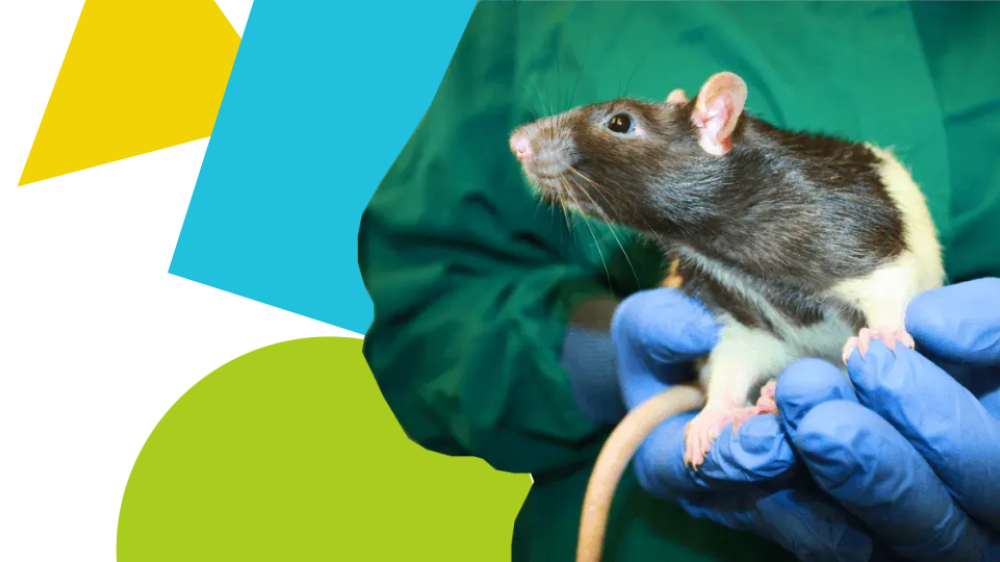
Handling and restraint: General principles
Guidance on best practices in handling and restraint for mice, rats and other laboratory rodents.
On this page
Introduction
Laboratory animals are inevitably subjected to human contact throughout their lives, during both husbandry and experiments. The use of appropriate and skilled handling is essential to ensure that animals readily accept or actively seek human contact and procedures are carried out efficiently. If routine handling procedures are aversive, animals are likely to develop anxiety and show exaggerated stress responses when approached. This is detrimental to animal welfare and will increase the difficulty of handling as animals attempt to avoid contact/restraint and may show defensive aggression. Handling stress can also be a major confounding variable and an unwanted source of variation within and between experiments. Good training in non-aversive handling has benefits for the animal, for the handler and for the reliability of data gained in experiments.
General considerations
Encouraging voluntary cooperation
The methods used to interact with and handle animals have a significant impact on their overall lifetime experience. Encouraging voluntary cooperation reduces fear and stress, making interactions safer, more predictable and, in many cases, more efficient. Voluntary cooperation is built through training and habituation and it can be achieved in just a few short sessions.
Reward training methods (also known as positive reinforcement), usually using food treats, work very effectively in dogs, non-human primates and pigs and can remove the need for restraint during procedures that animals would normally avoid. Mice and rats can also be easily habituated to handling and procedures using food rewards and gentle handling techniques. For further information see the NC3Rs page on training animals [2, 3, 4].
Training and experience: handlers and animals
Acquiring good handling skills needs training in appropriate methods and practice to be able to handle quickly and effectively regardless of the specific presentation of the animal, its behaviour and context. Skill should be sufficient to capture animals quickly, confidently and securely on first approach without any chasing. Failed attempts to catch an animal can increase its anxiety and lead to further evasive response, resulting in frustration and sometimes impatience in the handler.
Both handlers and animals learn from experience. Consistent use of non-aversive handling from a young age during routine husbandry is a fast and effective way to habituate animals to being handled by humans.
Approach
Animals should be approached in a calm and confident manner, avoiding exaggerated or sudden movements, such as waving of the hands and arms. Using soft tones and a quiet voice when talking to animals may help alert them to a non-threatening approach and reinforce a caring attitude in the handler.
Handling method
Choice of an appropriate method to pick up, carry and/or restrain an animal is a crucial aspect of handling. The method needs to be suited to the particular species (see specific recommendations below); any strain or individual differences also need to be taken into account. More anxious strains/individuals may be much slower to habituate to some methods, requiring further training and/or adjustment of handling techniques, until they are calm and have learned that handling is not a threat. In all cases, when lifting an animal their body should be appropriately supported.
Restraint
Correct positioning of both the handler and animal is necessary to achieve quick and secure restraint. Animals need to feel secure and to be completely immobile to avoid struggling, which would promote anxiety and could result in injury to the animal or handler. During restraint, animals should be held firmly and securely, but not so tightly that it causes discomfort, compromises the animal’s breathing or causes bruising.
Observing the animal's response
It is important to observe the animal’s behaviour during handling as this allows immediate adjustment to keep the animal secure and safe. However, observing the animal’s response on approach and after the animal has been released back into its home environment also provides invaluable information. Anxious animals will often flee from the handler on release and try to evade recapture or, less obviously, they may attempt to hide quietly to avoid attention. By contrast, animals with a positive response to handling are generally curious and will voluntarily approach the handler to investigate and interact. To check the effectiveness of your own handling procedures, try standing motionless for a short period after handling to assess whether animals approach and seek contact [1].
Rodents
Mice
Mice are by far the most commonly used vertebrates in research. Despite this, people find it harder to relate to mice than to more familiar companion animals and mouse behaviours can be harder to recognise and to understand. Their small size makes them vulnerable to predation or other harm, so it is not surprising that mice often show strong handling stress and anxiety in response to capture. Nonetheless, mice adapt readily to human contact if handled appropriately and will voluntarily seek contact, driven by their inquisitive nature.
Mice should be picked up using refined methods, such as a tunnel or cupped hands. The literature on refined mouse handling overwhelmingly shows that mice picked up using refined methods display lower anxiety and greater willingness to interact with handlers than mice picked up by the tail [1, 5, see also: Mouse handling research papers].
Although picking mice up by the tail was used widely in the past, we now know that it stimulates an inherent anxiety to being captured, to which mice do not readily habituate. Fortunately, there are now established methods to reduce handling-related stress in mice, which should be adopted these as the default. For further information on using refined methods to pick up mice, see our pages on mouse handling.
Restraint
Mice accustomed to being picked up using refined methods will accept physical restraint without losing tameness towards the handler. While mice should not be picked up by the tail, the base of the tail can be held to manipulate the mouse once on the hand. For full restraint, place mice on a surface they can grip. Holding the tail base securely, pull back gently to stimulate the animal to grip and use the other hand to grasp the loose skin at the back of the neck between thumb and forefingers. Care should be taken minimise pressure on the throat when scuffing mice (see Norecopa: A refined technique for scruffing mice). It is also possible to restrain mice without using tail restraint, by following the approach outlined in Davies et al. (2022) [6]:
"The mouse is placed onto the forearm and then completely covered gently with the other hand. When its head pokes out between the thumb and forefinger the animal is restrained by pinching the loose skin along the back of the animal between the thumb and forefingers in a similar way to a conventional tail handled restraint."
Whatever approach is taken to restrain mice, the animal should be immobilised but able to breathe easily. Further information on restraint of mice for specific procedures can be found on the Procedures With Care website.
Approaches to minimise the need for restraint of mice for procedures are shown in the webinar recording: Handling and training of mice and rats for low stress procedures.
Rats and other laboratory rodents
The principles that apply to mice generally apply to rats and other laboratory rodents, but species-specific differences in behaviour and size alter the specifics of handling procedures that work well in each species. Picking up rats by the tail is stressful and should be avoided [7]. The same is likely to be true of other rodent species. Picking rodents up by the tail increases the risk of degloving injuries (where the skin of the tail is pulled away from the underlining tissue).
For smaller rodents, handling tunnels can be used to transfer animals between cages, and also to habituate animals to being picked up from the cage. Rats habituated to handling can normally be picked up easily by grasping them around the shoulders.
Approaches to habituation and ways to minimise the need for restraint of rats for procedures are shown in the webinar recording: Handling and training of mice and rats for low stress procedures. Tickling is one method that can be used to habituate rats to handling – for more information and resources, visit our rat tickling pages. For details of methods of restraint for specific procedures, see Procedures With Care website.
Rabbits
Rabbits are prey species that find handling and restraint inherently stressful [8, 9]. Even rabbits socialised to humans will struggle, kick and exhibit other fear behaviours when picked up [8, 10]. Training rabbits to cooperate is strongly recommended for calmer and safer interactions for both the animals and handlers [8, 10, 11].
Rabbits can be trained to hop onto weighing scales, enter a transport carrier, and jump onto a handler’s lap, remaining there calmly while being examined [11]. If rabbits are not receptive to food rewards during training olfactory cues can also be effective. The ‘reward’ used to train rabbits to hop directly from their enclosure into this transport box was fleecy bedding scented by other males during playpen sessions (see page 4 of Tech3Rs Issue 15).
Rabbits are prone to spinal injuries so handling should always carefully follow recommended techniques. Note that the while the scruff of the neck may be used to secure a rabbit, they should not be lifted by the scruff and should always have their weight fully supported from below. Rabbits should never be lifted by the ears. For more information on the handling and restraint of rabbits see:
- ACT online training: How to pick up rabbits. This training video outlines key considerations for handling rabbits.
The following videos show the traditional techniques for how to lift a rabbit and how to restrain a rabbit.
Non-human primates
The guidelines on Non-human primate accommodation, care and use state that positive reinforcement techniques should be used to train primates to cooperate with capture, handling, restraint, husbandry and research procedures (e.g. weighing, body checks, dosing, sampling). Sufficient time should be allowed for this before studies commence. For more information on the handling and restraint of non-human primates see:
- EUPRIM-Net: Positive reinforcement training.
- The Macaque Website: Husbandry
- Common marmoset care: Handling and training.
- Chair training of non-human primates.
Dogs
Laboratory dogs are often compliant during handling but passive compliance should not be mistaken for voluntary cooperation; even well‑socialised dogs may become fearful during restrictive procedures [12]. Training and habituation to handling and restraint are therefore strongly recommended. Approaches that minimise or avoid restraint, such as allowing dogs to walk freely between locations, should also be used wherever possible. Dogs readily form relationships with human handlers and typically find positive‑reinforcement training socially rewarding, providing an excellent foundation for teaching cooperative behaviours [13]. For more information on the handling and restraint of dogs see:
Aquatic species
- RSPCA – Housing and care in aquatic species.
- CCAC – Guidelines on care and use of fish.
- American Fisheries Society – Guidelines for the use of fishes in research.
- RSPCA – Guidance on the housing and care of zebrafish Danio rerio.
References
- Hurst JL and West RS (2010). Taming anxiety in laboratory mice. Nature Methods 7: 825–826.
- Prescott MJ et al. (2005). Training laboratory-housed non-human primates, Part 2: Resources for developing and implementing training programmes. Animal Technology and Welfare 16:133–148.
- Prescott MJ et al. (2004). Refining dog husbandry and care: Eighth report of the BVA(AWF)/FRAME/RSPCA/UFAW Joint Working Group on Refinement. Laboratory Animals 38 (S1): 1-94.
- Hubrecht R and Kirkwood J (Eds) (2010). UFAW Handbook on the Care and Management of Laboratory and other Research Animals, 8th Edition, Wiley-Blackwell.
- Gouveia K and Hurst JL (2013). Reducing mouse anxiety during handling. PLOS ONE 8(6): e66401.
- Davies, JR et al. (2022). Impact of refinements to handling and restraint methods in mice. Animals 12(17), 2173. doi: 10.3390/ani12172173
- Deacon RMJ (2006). Housing, husbandry and handling of rodents for behavioural experiments. Nature Protocols 1: 936–946.
- Thurston S and Ottesen JL (2020). The rabbit, in Animal-centric Care and Management. CRC Press. p. 135-148.
- McIndoe KS et al. (2023). The effect of blindfolding and swaddling on the stress response to handling in domestic rabbits. Animal Welfare 31(1): p. 27-36. doi: 10.7120/09627286.31.1.003
- Bradbury and Dickens (2016). Appropriate handling of pet rabbits: a literature review. Journal of Small Animal Practice. 57(10), 503-509. doi: 10.1111/jsap.12549
- Hohlbaum K et al. (2024). Training laboratory rabbits to refine routine husbandry procedures. JoVE (204): p. e66008. doi: 10.3791/66008
- Cisneros A et al. (2025). Handle with care: dogs show negative responses to restrictive handling restraints and tools during routine examinations. Applied Animal Behaviour Science 286:106601. doi: 10.1016/j.applanim.2025.106601
- Hall LS and Boxall J (2024). The laboratory dog. The UFAW Handbook on the Care and Management of Laboratory and Other Research Animals: 518-545. doi: 10.1002/9781119555278.ch30
Using refined handling methods and positive reinforcement techniques reduces the distress experienced by the animal and the handler. Both rats and mice can form positive associations with human handling if provided with the opportunity.