
NC3Rs: National Centre for the Replacement Refinement & Reduction of Animals in Research
News

Bridging the gap: New funding for academic-industry partnerships between NC3Rs Network members
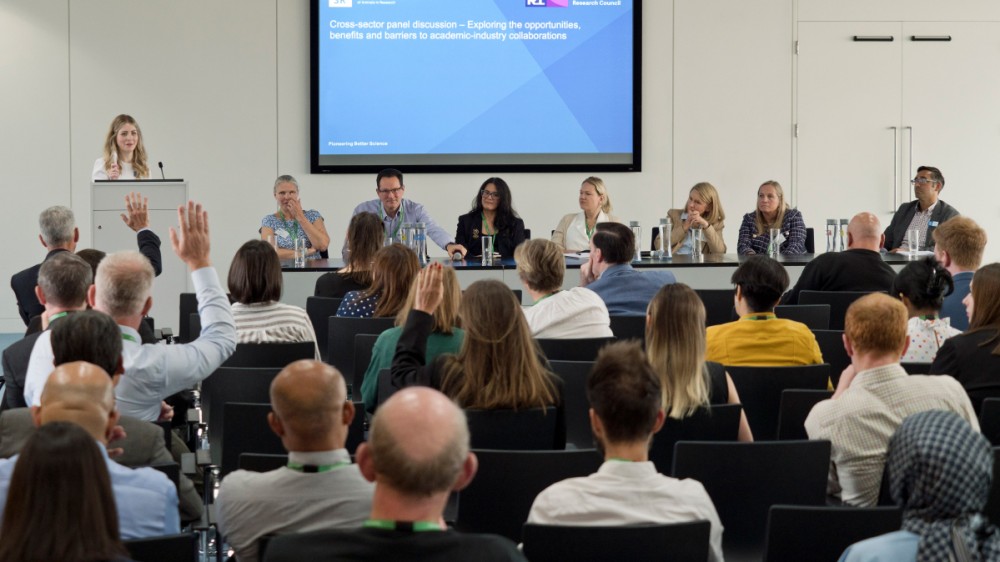
A panel discussion with audience members raising hands to ask questions

In partnership with the BBSRC we have awarded over £200k to strengthen cross-sector collaborations that improve the relevance and real-world impact of 3Rs models and technologies.

The NC3Rs and BBSRC are pleased to announce nine teams have each been awarded funding of up to £25k through a new joint funding initiative, Business Interaction Vouchers. Available exclusively to members of the NC3Rs Networks, the scheme was designed to catalyse new relationships and support early-stage collaborative projects to advance the 3Rs between academic researchers and partners in industry and SMEs.

These short and focused awards will enable the funded academic groups to collaborate with a range of multinational and SME industry partners. The projects will generate data and explore the technical developments or model adaptations needed to enhance the biological relevance and real-world applicability of 3Rs approaches, with industry partners providing access to equipment, reagents and specialist technical expertise.

“Through the NC3Rs dedicated Networks, in oncology, cardiovascular sciences and new approach methodologies we bring together researchers and industry to share 3Rs expertise and knowledge. These new Business Interaction Voucher awards in partnership with the BBSRC will support Network members to build new collaborations and generate the early data and technical advances needed to move promising 3Rs models towards wider real-world use.”

– Dr Katie Bates, Head of Research Funding, NC3Rs

"Business Interaction Vouchers support strategic R&D partnerships between businesses and academic researchers, helping to catalyse the development of tools, technologies, and methodologies that reduce reliance of the use of animals in research, whilst also advancing capabilities that could one day be more powerful than current animal models. This new strategic portfolio of projects supported across the NC3Rs networks, through joint investment with BBSRC, covers a broad and exciting range of new 3Rs innovations which will drive innovation across the sector.” 

– Dr Lee Beniston FRSB, Associate Director for Industry Partnerships and Collaborative Research and Development, BBSRC

Cardiovascular sciences

Professor Cesare Terracciano, Imperial College London

Exploring the cardiotoxic effects of AZD5991 in human living myocardial slices (£24,734)

Cesare will use his award to generate pilot data using an ex vivo human myocardial slice model, previously developed with NC3Rs funding, as a tool to detect early indicators of cardiotoxicity. Working in partnership with AstraZeneca, the team will assess how the model responds to AZD5991, a molecule that was halted in phase 1 clinical trials due to cardiotoxicity of uncertain clinical significance, helping to support the use of the human slice model for mechanistic toxicity purposes.

Oncology

Professor Gareth Cave, Nottingham Trent University

Development of a vascularised glioblastoma tumour-on-chip for predictive, non-invasive chemotherapeutic evaluation (£25,000)

Gareth will use his award to establish a vascularised glioblastoma tumour-on-a-chip model using human cells to replace the use of mice in early cancer treatment studies. His team will combine their existing 3D scaffold technology, which supports the formation of a functional blood-brain barrier, with Kirkstall Ltd’s Quasi Vivo® microfluidic system. The integrated setup will be tested with chemotherapeutic agents to assess barrier integrity, tumour cell responses and drug permeability across the blood-brain barrier. The team will also develop standard operating procedures for scaffold integration, cell seeding, media formulation and perfusion to support wider adoption of the model.

Dr Tim Hopkins, Queen Mary University of London

Advancing animal-free organ-on-a-chip models with PeptiMatrix (£25,000)

Tim will assess whether PeptiMatrix™, a commercially available synthetic hydrogel developed with NC3Rs funding, can replace animal-derived matrices in organ-on-a-chip models used to study cancer metastasis to the bone. His team will evaluate chemically-defined hydrogels of different physiologically-relevant stiffnesses to determine their ability to transmit mechanical loading, support bone cell viability and phenotype, and generate biomechanical responses characteristic of bone tissue. Current in vitro models of bone metastasis rely on animal-derived matrices that often lack physiological relevance, and this study will assess the suitability of PeptiMatrix™ as a defined animal-free alternative for these models. 

Dr Paloma Ordóñez-Morán, University of Nottingham

Advanced 3D in vitro modelling of inflammatory bowel disease for evaluating biologic treatment efficacy and enabling computational analysis (£22,872)

Paloma will work with AstraZeneca to use patient-derived organoids as an in vitro model to study inflammatory bowel disease, a condition associated with increased colorectal cancer risk. Current studies typically rely on chemically or genetically inducing colon damage in mice. By retaining patient-derived characteristics, the organoids will enable the team to assess phenotypic and molecular responses to clinically-relevant compounds. The experimental data will then be integrated with existing clinical datasets using computational approaches to carry out preliminary analyses of treatment responses and disease progression.

New approach methodologies for use in assessing chemical or drug toxicity

Dr Jessica Ewald, European Bioinformatics Institute, European Molecular Biology Laboratory

Using large language models to make in vivo toxicity endpoints machine learning-ready (£25,000)

Jessica will assess how accurately in vitro approaches, such as high-throughput cell-based assays, can predict toxicology outcomes traditionally obtained from animal studies. Working with AstraZeneca, she will apply in silico tools to standardise the language used in historical animal toxicity reports, converting them into structured toxicity endpoints suitable for machine-learning analysis. The resulting datasets will enable preliminary comparisons of toxicological outcomes from animal and non-animal studies, providing an initial indication of the reproducibility of animal safety tests and data that could inform performance benchmarks for new approach methodologies in safety assessment.

Professor Felicity Gavins, Brunel University of London

Developing human neutrophil-T-cell co-culture assays to refine off-target immunotoxicity testing of T-cell receptor-based therapeutics (£25,000)

Felicity will work with King’s College London (KCL) and industry partner Immunocore to  advance human cell-based assays for the preclinical safety assessment of T-cell receptor (TCR)-based therapeutics. Current immunotoxicity tests rely heavily on animal models which offer limited insight into human immune responses due to differences between species. The team will combine Immunocore’s T-cell and neutrophil assays into a co-culture system to better capture complex immune cell interactions and predict unwanted immune activation in response to TCR-based therapeutics. High-precision single cell analysis will be used to generate novel multidimensional datasets, which will be analysed using artificial intelligence to identify high-dimensional signatures of immune activation and potential off-target effects. These data will help evaluate how the co-culture model could support preclinical safety studies and improve the identification of immunotoxicity risks. 

Dr Julia Mantaj, London South Bank University

Human microphysiological model of chemotherapy-induced intestinal injury and repair for predictive toxicology (£22,500)

Julia will work with industry partner MEPSGEN to adapt their commercially available microphysiological system for use as a model of the human small intestine in gastrointestinal toxicology studies. By incorporating organoid-derived cells, her team will establish a system capable of reproducing chemotherapy-induced mucositis, an inflammatory injury of the intestinal lining that is typically studied in animal models. The team will characterise how intestinal barrier damage and repair occur within the in vitro system. These responses will be compared with 2D models and existing in vivo data, providing insight into mechanisms of treatment-related intestinal toxicity.

Dr Katarzyna Pirog, Newcastle University

Novel bioprinting technologies for engineering of compressible zonally stratified cartilage tissue for study of therapeutic interventions (£24,813)

Katarzyna will work with researchers from across Newcastle and Northumbria Universities and in close collaboration with industry partner Copner Biotech. Combining expertise in biosciences, engineering, and advanced materials the team will use advanced bioprinting technologies to generate cartilage-like structures for investigating the biological mechanisms involved in cartilage development, ageing and disease. Using Copner Biotech’s next generation 3D modelling software and bioprinting platform, the team will combine a variety of bioinks to produce constructs with defined microarchitectures. The developed in vitro models will be compared against existing data from human samples and animal studies to assess the physiological relevance and suitability for safety testing of senolytic (i.e. those that selectively induce the death of senescent cells) drugs used to treat osteoarthritis.

Professor Dame Molly Stevens, University of Oxford

Co-developing dynamic human skin models for industrial validation and 3Rs impact (£24,672)

Molly will work with LabSkin Ltd to enhance the physiological relevance of in vitro skin models for efficacy and safety testing, an area where animal studies such as the minipig wound healing assay remain in use. Her team will integrate a microfluidic culture platform developed at the University of Oxford with LabSkin Ltd’s commercially available human skin model and will assess how biomechanical stimulation affects skin architecture, maturity and barrier function. The study will generate preliminary data to assess the performance characteristics and predictivity of the integrated system.


About the NC3Rs Networks

The NC3Rs Networks were established in 2024 and currently bring together 1,263 researchers and stakeholders from over 490 organisations to maximise the impact of 3Rs innovations in key scientific areas. The Networks focus on areas with significant potential to apply and advance 3Rs models including cardiovascular sciences, oncology and new approach methodologies for use in assessing chemical or drug toxicity. They are open to scientists and stakeholders at all career stages from across academia and industry. 
Network members have access to:

  • A cross-sector community of researchers working on similar scientific and 3Rs challenges.
  • Opportunities to connect with potential collaborators across academia and industry.
  • Regular scientific meetings, workshops and webinars highlighting developments in 3Rs models and methods.
  • A forum for sharing protocols, experiences and practical insights to support the uptake of 3Rs approaches.
  • Engagement with NC3Rs staff who facilitate discussions around research needs, model development and areas where 3Rs impact can be achieved.
  • Exclusive opportunities to apply for Network-specific funding, including Business Interaction Vouchers and Network Primer Awards.

NC3Rs and BBSRC working together 

The BBSRC and NC3Rs have a long-standing partnership, with joint investments of more than £4.3M over the past three years through funding calls aimed at accelerating the development and adoption of 3Rs approaches. These initiatives have supported the development of non-animal technologies to advance predictive biology through research grants, and have enabled researchers to explore commercial opportunities for emerging 3Rs-relevant technologies, products and services through the ICURe programme. These new Business Interaction Vouchers extend this partnership by strengthening academic-industry links and supporting early-stage projects to improve the relevance of 3Rs models and technologies.